


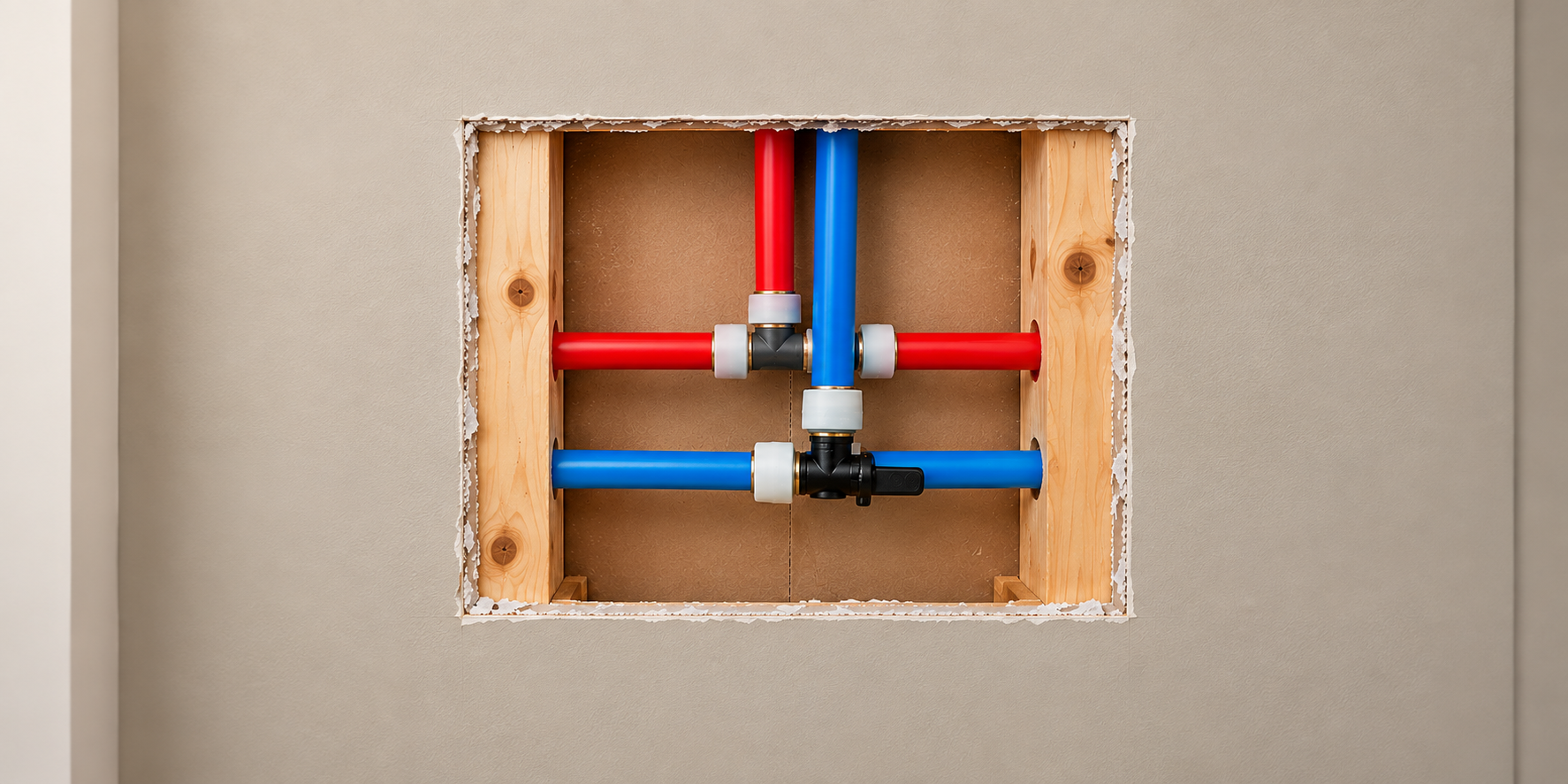
For most Valley homes, PEX is the lower-cost repipe material, and copper is the premium choice for homeowners who want metal pipe and are willing to pay more. Both are approved for drinking water, and both can last decades when installed correctly. The better choice depends on your water, where the pipe will run, and your budget.
This guide covers what matters in Arizona specifically: hard water, summer heat, attic runs, and cost. If you are already seeing leaks, discolored water, or low pressure, start with our whole-home repipe page.
The Short Answer
- Choose PEX if you want the lowest installed cost, fewer joints inside your walls, and a material that does not corrode.
- Choose copper if you prefer metal pipe, need heat and sun tolerance for exposed runs, and are comfortable with a higher material cost.
- Either way, the installer matters more than the material. A poorly installed system fails early no matter what it is made of.
What Valley Water Does to Pipe
Arizona water is hard. The City of Phoenix reports total hardness of 10 to 17.6 grains per gallon, and notes that hard water can cause scaling in pipes and water heaters. Phoenix also disinfects its entire supply with chlorine, and its published pH runs from 6.6 to 8.8. Mesa, Peoria, and Surprise publish their own reports, so check your city’s numbers.
Why this matters for your pipe choice:
- Scale builds up inside metal pipe and narrows it, which shows up as low pressure at several fixtures.
- Water chemistry affects copper corrosion. EPA research found copper pitting did not occur at pH 6.5 or 7, appeared at pH 8 only with higher chlorine, and was reproduced at pH 9. Virginia Tech researchers also reproduced pinhole leaks in the lab using water with high chlorine, relatively high pH, and aluminum solids.
- PEX does not corrode. It is plastic, so it does not pit or rust, and it resists deterioration from scale and chlorine buildup.
That does not mean copper fails in every Valley home. Many copper systems here have lasted decades. It means copper’s performance depends more on water chemistry than PEX’s does. We cover this further in Copper Pinhole Leaks: Patch Them or Repipe?.
If hard water is your main concern, a water softener or whole-home filtration protects whichever pipe you choose, along with your water heater.
Cost: PEX vs Copper
Nationally, the average homeowner spends about $7,500 to repipe a house, with a typical range of $1,500 to $15,000. Material alone shows the gap:
| Material | Average cost per linear foot |
|---|---|
| PEX | $0.40 to $2 |
| Copper | $2 to $8 |
Labor is the bigger number, at roughly 70 percent of a repipe bill, because the work involves opening walls, running new lines, and patching drywall. PEX lowers labor too. It bends around corners and snakes through small openings without a fitting at every turn, while copper needs a soldered or pressed joint at each change of direction.
The number that matters is your quote. Home size, number of bathrooms, one story or two, and attic or slab access all move the price. We give a flat-rate quote after looking at your system, and we offer a free second opinion if you already have a quote in hand.
Heat, Sun, and Attic Runs
This is where Arizona differs from most of the country. Many Valley homes are built on slabs, so repipes often run new lines through the attic.
PEX has firm temperature and sunlight limits.
- PEX plumbing pipe is rated for 160 psi at 73.4°F and 100 psi at 180°F under ASTM F876.
- Industry guidance says not to install PEX where water temperature can exceed 180°F.
- PEX is not intended for outdoor use or direct sunlight. Its UV rating, printed on the pipe, ranges from not rated up to 6 months of exposure.
In practice, PEX in an attic should be shielded from sunlight from vents and skylights, kept off hot surfaces, and supported properly. Exposed outdoor runs, like a hose bib or a line to an outdoor kitchen, are usually better in copper.
Copper handles heat and UV well. Copper won’t deteriorate from UV exposure. That is why many Valley repipes are a mix: PEX for interior runs, copper where pipe is exposed outdoors.
Drinking Water Safety
Both materials are approved for drinking water when certified.
- PEX for drinking water must be tested and certified to NSF/ANSI Standard 61. Look for “NSF-pw” printed on the pipe.
- PEX chlorine rating is the first digit of the material code on the pipe. A “5” means it is rated for continuous hot water at 140°F, the toughest condition in the standard. This matters in homes with a hot water recirculation pump.
- Odor and taste: Purdue University research found some PEX can cause a foul odor in new installations. Flushing the system after install usually addresses this.
- Copper is a long-standing drinking water material. Copper and lead in tap water come mainly from corrosion of household plumbing, and Phoenix tap samples met the federal action level.
If You Choose Copper, Ask Which Type
Copper water tube comes in three common types. Type K has the thickest wall, Type L is in the middle, and Type M is the thinnest.
- Type K (green print): thickest wall, often used for underground water service.
- Type L (blue print): medium wall, a common choice for interior repipes.
- Type M (red print): thinnest wall and lowest cost. Both the International Plumbing Code and the Uniform Plumbing Code allow it for water distribution inside a home.
Two copper quotes can differ by thousands partly because of tube type. Ask which type is in each quote so you are comparing the same thing.
Side-by-Side Comparison
| Factor | PEX | Copper |
|---|---|---|
| Material cost per foot | $0.40 to $2 | $2 to $8 |
| Corrosion and pitting | Does not corrode | Can pit, depending on water chemistry |
| Hard water scale | Resists scale buildup | Scale can build inside over time |
| Heat limit | 180°F at 100 psi | Handles higher heat |
| Sunlight | Must be protected from UV | Not affected by UV |
| Joints in walls | Fewer (flexible) | More (rigid, fitting at each turn) |
| Freezing | Less likely to burst | Can burst if frozen |
| Drinking water | NSF/ANSI 61 certified | Long-standing approved material |
When PEX Is the Better Fit
- You are replacing galvanized, polybutylene, or failing copper and want the lowest cost per bathroom.
- You have had pinhole leaks in your current copper and want a material that does not pit.
- Your new lines will run inside walls and a shaded attic, not in direct sun.
- You want fewer joints behind drywall, since every joint is a possible leak point.
When Copper Is the Better Fit
- You want metal pipe by preference or to match a high-end remodel.
- Lines will be exposed to sun or high heat.
- You are doing a partial repipe and want to match existing copper that is in good condition.
Questions to Ask Before You Sign a Repipe Quote
- Is the quote PEX, copper, or a mix, and where does each run?
- If copper, is it Type L or Type M?
- If PEX, what brand, and what are its chlorine and UV ratings?
- How will attic runs be protected from heat and sunlight?
- Is drywall patching included, and is a permit pulled?
- Who does the work, employees or subcontractors?
- What is the labor warranty, and is it transferable if you sell?
At Patriotic Plumbing & Rooter, every plumber on your job is our employee, never a subcontractor. Labor carries a transferable lifetime warranty, and PEX carries a 25+ year manufacturer warranty. See how we approach whole-home repiping.
Repiping in Mesa, Peoria, and Surprise
We have offices in the East and West Valley and repipe homes across the Phoenix area, including Mesa, Peoria, and Surprise. Arizona’s expansive clay soil adds stress to buried lines, and a repipe is one of the plumbing upgrades that help resale value.
Frequently Asked Questions
Can PEX be installed in a Phoenix attic? Yes, when it is protected from sunlight and kept below its 180°F limit. PEX is not rated for direct UV exposure, so it should be shielded from vents and skylights and kept off hot surfaces.
Does PEX make water taste like plastic? Sometimes, briefly, after a new install. Purdue research found odor from some new PEX. Flushing usually clears it, and certified PEX meets NSF/ANSI 61 for drinking water.
Will a water softener help my new pipes last longer? It helps copper, fixtures, and your water heater the most. PEX already resists scale buildup. See our water softener services.
Is Type M copper good enough for a repipe? It meets code for water distribution inside a home, but it has the thinnest wall of the three types. Many homeowners who choose copper ask for Type L.
How can I tell what PEX my plumber is installing? Read the printing on the pipe. It lists the ASTM standard, the pressure rating, the NSF listing, and a material code whose first digit is the chlorine rating and second digit is the UV rating.
Get a Straight Answer for Your Home
The right material depends on what is in your walls now, your water, and how your home is built. We will look at your system, tell you what we would use and why, and give you a flat-rate quote in writing. Schedule a repipe estimate or call 602-755-9373.


 Main Office (602) 755-9373 |