


Most sewer line problems in Phoenix don’t announce themselves all at once. They build slowly. A drain that takes a little longer to clear. A smell that comes and goes. A patch of grass in the backyard that’s greener than the rest.
By the time homeowners connect those things to a sewer line problem, the damage is usually further along than it needed to be.
Phoenix sewer lines fail faster than most parts of the country for specific reasons. Clay soil that expands and contracts every monsoon season. Hard water that accelerates pipe corrosion. Mature tree root systems in established neighborhoods that have been growing toward moisture for decades. And a significant portion of the Valley’s housing stock has original clay or cast iron sewer laterals that are 40 to 60 years old.
This guide covers what a failing sewer line actually looks and feels like, what’s causing it in Phoenix, what happens to your home if you wait, and what your repair options are when you’re ready to fix it.
7 Warning Signs Your Phoenix Sewer Line Needs Repair
These are the signs plumbers look for and the ones homeowners most commonly report before a main line failure. Pay attention if you’re seeing more than one.
1. Multiple Drains Running Slow at the Same Time
A single slow drain is almost always a localized clog. Hair in the bathroom, grease in the kitchen, a small blockage at the trap.
When multiple drains in the house are slow at the same time, the problem is in the main sewer line, not in individual branch lines. If the kitchen sink, the guest bathroom, and the laundry drain all seem sluggish within the same time period, that’s a main line signal.
2. Recurring Main Line Backups
If you’ve had your main line cleaned and the backup came back within a few weeks or months, the cleaning cleared a symptom without fixing the cause. Recurring backups mean something about the pipe itself is creating conditions for debris to accumulate repeatedly. Root intrusion, a belly in the line, or a deteriorated pipe wall that builds up scale faster than normal are the most common causes in Phoenix.
Clearing the line again will provide temporary relief. Camera inspection is the only way to find out why it keeps coming back.
3. Sewer Odor Inside or Outside the Home
A properly functioning sewer line is sealed. You shouldn’t smell it. When you do, it means gas is escaping through a crack, a separated joint, or a section of pipe that has deteriorated enough to allow gases through.
Inside odors that don’t go away after running water in unused drains, checking toilet wax seals, and cleaning floor drains are worth investigating with a camera. Outside odors near where your sewer lateral runs to the street connection are a stronger signal.
4. Gurgling Sounds from Drains
When water drains and you hear a gurgling sound from other fixtures, air is being displaced through the line. This usually means there’s a partial blockage or a belly in the pipe where sewage is pooling and restricting the flow of air and water through the system.
A toilet that gurgles when you run the washing machine, or a shower that gurgles when the toilet flushes, is a common pattern in Phoenix homes with main line issues.
5. Wet Patches or Unusually Green Grass in Your Yard
In Phoenix’s dry climate, a section of your yard that stays wet without irrigation or has noticeably greener grass than surrounding areas is a strong indicator of a sewer line leak underground. Sewage is an effective fertilizer, which is why the grass directly above a leaking sewer lateral is often visibly healthier than the rest.
Pay attention to whether the wet or green area corresponds to the path your sewer line takes from the house to the street.
6. Cracks in Your Driveway or Patio
A leaking sewer line under or near a concrete driveway or patio saturates the soil underneath, which can cause uneven settling and cracking in the surface above. In Phoenix where clay soil responds dramatically to moisture changes, a sewer leak underground can shift enough soil to cause visible cracking in adjacent concrete within months.
New cracks that appear relatively quickly, especially in an area where you have other sewer symptoms, are worth connecting.
7. Increased Pest Activity Near the Sewer Line
Rodents and cockroaches actively seek out sewer line cracks as entry points into homes. If you’ve noticed increased pest activity inside your home and you’re also experiencing other sewer symptoms, a cracked lateral is a possible entry point worth inspecting.
What Causes Sewer Line Damage in Phoenix
The same symptoms show up in cities across the country but Phoenix has specific conditions that accelerate sewer line deterioration faster than most markets.
Clay Soil Expansion and Contraction
The soil under most Phoenix properties has high clay content. Clay soil absorbs water during monsoon season and expands. When it dries out in the months after, it contracts. This cycle repeats every year and puts constant stress on underground pipe joints and connections.
Over decades, this movement shifts pipe sections, opens joint gaps, and in older clay pipe can fracture the pipe itself. A sewer lateral that was installed perfectly level can develop bellies and offset joints just from soil movement over 20 to 30 years.
Root Intrusion from Mature Landscaping
Established Phoenix neighborhoods, particularly those built in the 1970s and 1980s, have mature trees and palms whose root systems have been expanding for 40 to 50 years. Tree roots follow moisture, and a sewer lateral is a reliable moisture source.
Any crack or joint gap in a sewer pipe becomes an entry point. Roots infiltrate, expand inside the pipe as they grow, and eventually cause the blockages and structural damage that require professional repair. Root intrusion is one of the most common causes of recurring main line backups in Phoenix’s established neighborhoods.
Aging Clay and Cast Iron Pipe
Most Phoenix homes built before 1980 have sewer laterals made of clay or cast iron. Clay pipe joints were sealed with materials that deteriorate over time. Cast iron corrodes internally from hard water exposure and develops buildup that narrows the pipe and eventually cracks it.
Both materials fail suddenly rather than gradually. A sewer lateral that has been in service for 50 years may appear to be functioning until the day it doesn’t.
Hard Water Buildup Inside the Pipe
Phoenix’s mineral-heavy water deposits scale inside sewer lines over time, narrowing the effective diameter. This is less dramatic than root intrusion or pipe collapse but compounds the other issues. A line that already has some root intrusion or a slight belly accumulates debris much faster when the pipe walls are roughened by scale buildup.
The Difference Between a Clog and Sewer Line Damage
This is the question that matters most for deciding what repair you actually need.
A clog is a blockage inside an otherwise intact pipe. The pipe structure is fine. Something is blocking the flow. Drain cleaning clears it and the problem is resolved.
Sewer line damage is a structural problem with the pipe itself. A crack, an offset joint, a belly, root intrusion that has compromised the pipe wall, or a section that has collapsed. Drain cleaning clears the current blockage but the pipe condition creates the same problem again within weeks or months.
The way to know which you’re dealing with is a camera inspection. A camera goes into the line and shows what’s actually there. If the pipe is structurally intact and there’s a debris blockage, clean it and you’re done. If the camera shows roots, cracks, offsets, or a belly, you have a pipe condition issue that cleaning won’t fix.
Skipping the camera to save money on the inspection often means paying for repeated drain cleaning calls that keep clearing the same underlying problem without ever solving it.
Sewer camera inspection is the only diagnostic tool that shows the actual condition of your sewer lateral.
What Happens If You Delay Sewer Line Repair in Phoenix
Sewer line problems get worse, not better. Here’s what typically happens when a failing sewer line isn’t addressed.
Sewage backup into the home. A partially blocked or damaged sewer line eventually becomes fully blocked. When that happens, sewage has nowhere to go except back up through the lowest drains in the house. Floor drains, ground-floor toilets, and showers are the most common locations. Sewage backup inside a home is a health hazard and causes significant material damage.
Soil saturation and foundation effects. In Phoenix’s clay soil, a leaking sewer line saturates the surrounding soil and causes it to expand unevenly. Over time this creates voids, settling, and cracking above the line. In severe cases it affects the foundation.
Health risks from sewage exposure. A leaking sewer lateral releases bacteria and pathogens into the surrounding soil and potentially into groundwater. If the leak is close to the house, gases can enter through foundation cracks.
Cost escalation. A spot repair to a small cracked section costs significantly less than a full lateral replacement. Waiting until the line has progressed from a manageable crack to a complete failure typically means the more expensive repair is the only option left. Catching the problem early, even if it still requires repair, gives you more options and more affordable ones.
Sewer Repair Options in Phoenix
Once camera inspection confirms a sewer line problem, there are typically two paths depending on what the camera shows.
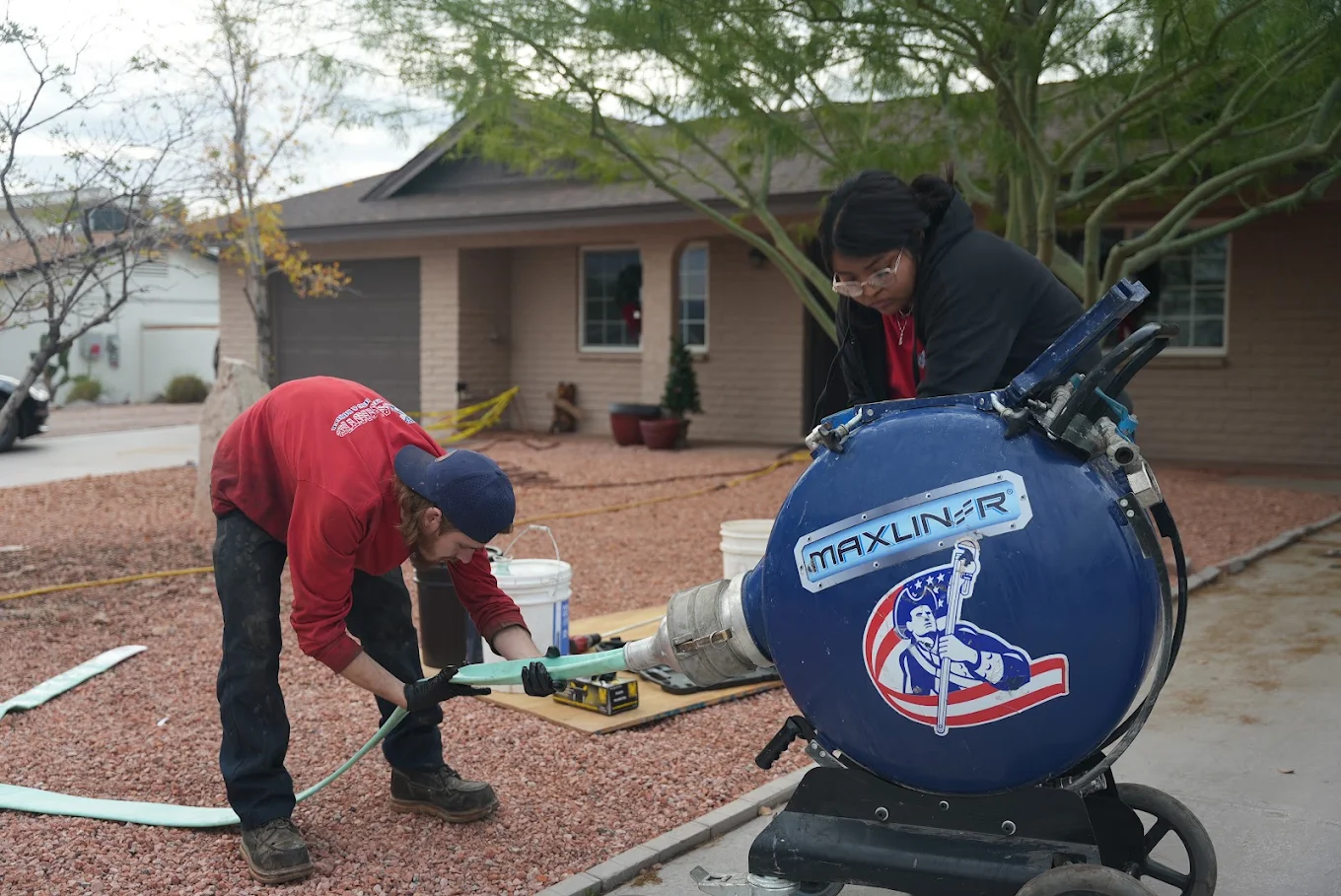
Trenchless sewer repair is appropriate when the pipe is structurally present but damaged. Pipe bursting replaces the line by pulling a new pipe through the old one without excavating your yard. CIPP lining creates a new pipe wall inside the existing one. Both methods access the line from small points at each end without a full trench.
Traditional repair or replacement is necessary in cases of severe collapse, extreme offset, or access constraints that prevent a trenchless approach. A plumber who is honest about your options will tell you when traditional repair is the better choice for your specific situation rather than fitting every job into the trenchless category.
Learn more about trenchless sewer repair options
Frequently Asked Questions
How long does a sewer line last in Phoenix? Clay sewer laterals have a typical lifespan of 50 to 60 years. Cast iron is similar. PVC, which became standard from the late 1970s onward, can last significantly longer. Phoenix’s specific soil conditions and hard water mean clay and cast iron lines here often show significant deterioration before the end of their expected lifespan.
Does homeowners insurance cover sewer line repair in Phoenix? Standard homeowners insurance policies typically don’t cover gradual sewer line deterioration. Sudden and accidental damage may be covered depending on your policy. Some insurers offer separate sewer line coverage as a rider. We provide full documentation to support your claim regardless of the coverage situation.
How much does sewer line repair cost in Phoenix? Cost depends on the method, the length of the line, and the extent of damage. We provide flat-rate quotes before any work begins. A camera inspection is the first step and gives us the information we need to quote accurately.
Can I use my drains while waiting for sewer repair? If the line is partially blocked you may be able to use drains carefully for a short period. If you’re experiencing backups, minimize water use until the line is repaired to avoid sewage coming back into the house. We’ll give you specific guidance based on what the camera inspection shows.
How long does sewer line repair take in Phoenix? Most trenchless sewer repairs are completed in one to two days. Traditional repairs involving excavation typically take longer depending on the scope of work.
Call us at 602-755-9373 for same-day camera inspection and a flat-rate repair quote.



 Main Office (602) 755-9373 | 2001 W Cheryl Dr, Ste 1B, Phoenix, AZ 85021